The Strength-Longevity Link is becoming one of the most fascinating discoveries in modern longevity science.
Most people monitor body weight, cholesterol, blood pressure, and blood sugar. However, researchers have identified another powerful indicator of long-term health that often receives far less attention: muscular strength.
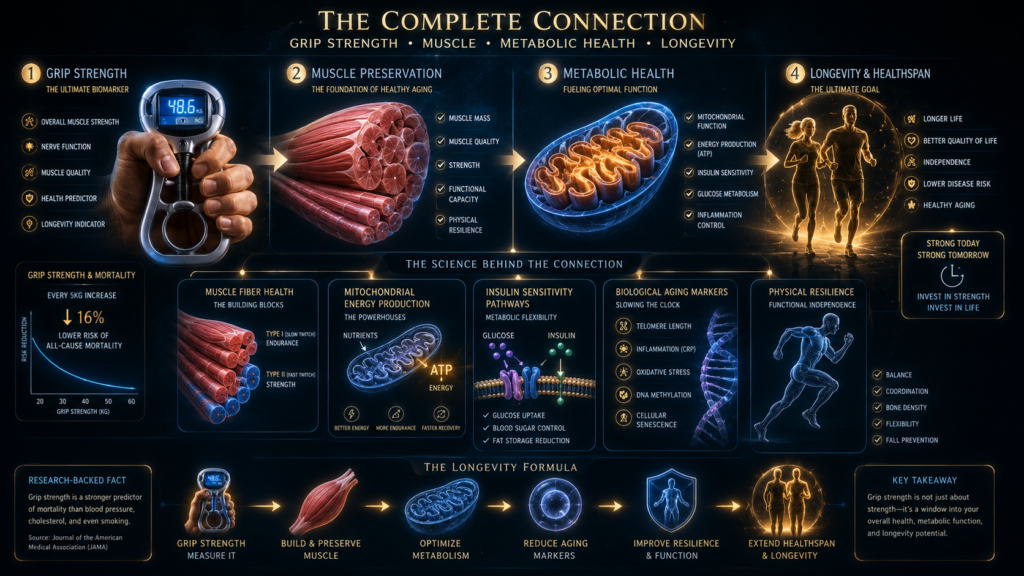
In particular, grip strength has emerged as one of the strongest predictors of healthy aging, physical resilience, metabolic function, and longevity.
Understanding the Strength Longevity Link may help explain why maintaining strength after age 30 is far more important than simply maintaining a lower number on the scale.
1.What Is Grip Strength?
Grip strength measures the force generated by the muscles of the hands and forearms.
While it may appear to be a simple physical test, grip strength reflects the health of multiple physiological systems, including:
- muscle mass;
- nervous system function;
- metabolic health;
- mobility;
- overall physical capacity.
Researchers increasingly view grip strength as a practical biomarker of biological aging.

2.Why Strength Matters More Than Weight:
Many adults focus primarily on body weight.
However, two individuals with identical body weights may have dramatically different health outcomes.
The difference often lies in:
- muscle quality;
- physical strength;
- metabolic resilience;
- body composition.
Higher strength levels are frequently associated with:
- better insulin sensitivity;
- healthier body composition;
- improved mobility;
- reduced risk of chronic disease.
3.The Strength-Longevity Link and Metabolic Health:
Muscle tissue plays a critical role in glucose regulation.
Healthy muscle acts as a major storage site for glucose and helps maintain insulin sensitivity.
As muscle strength declines, the risk of metabolic dysfunction may increase.
This relationship helps explain why strength is closely connected to:
- metabolic flexibility;
- glucose regulation;
- body composition;
- healthy aging.
Related reading:
The Metabolic Biomarkers Every Adult Over 30 Should Track (And How to Optimize Them Naturally)
4.What Research Says About Grip Strength:
Numerous studies have found that lower grip strength is associated with:
- increased mortality risk;
- reduced physical function;
- higher rates of cardiovascular disease;
- greater risk of disability.
Researchers now view grip strength as a valuable tool for evaluating overall health status.
Because the test is simple, inexpensive, and highly reproducible, it has become increasingly popular in longevity research.
5.Strength, Muscle Preservation, and Aging:
After age 30, adults naturally begin to lose muscle mass and strength if no action is taken.
This process is often gradual and may go unnoticed for years.
Over time, however, declining strength can contribute to:
- lower energy levels;
- reduced metabolic rate;
- increased fat accumulation;
- loss of functional independence.
Preserving strength is therefore one of the most effective strategies for promoting healthy aging.
6.How to Improve Grip Strength and Overall Strength:
Resistance Training
Strength training remains the most effective intervention for maintaining muscle and metabolic health.
Prioritize Protein Intake
Adequate protein supports muscle repair and recovery.
Improve Metabolic Health
Better glucose regulation and insulin sensitivity support muscle function.
Related reading:
The Estrobolome Connection: How Gut Dysbiosis Blocks Fat Loss After 30
Maintain Aerobic Fitness
Cardiovascular fitness and muscular strength work together to support longevity.
Related reading:
Zone 2 Cardio and Metabolic Longevity: Why VO₂ Max Dictates Your Fat-Burning Potential After 30
7.Strength as a Longevity Biomarker:
The Strength-Longevity Link highlights a major shift in how researchers evaluate health.
Rather than focusing exclusively on body weight, experts increasingly recognize that:
- strength matters;
- muscle quality matters;
- physical function matters.
For many individuals, strength may provide a more meaningful picture of future health than weight alone.
Scientific Evidence: For readers interested in exploring current scientific research, visit: PubMed – Grip Strength and Longevity https://pubmed.ncbi.nlm.nih.gov/?term=grip+strength+longevity
🧬Support Healthy Muscle and Cellular Energy
Strength and longevity depend on more than exercise alone.
Healthy muscle tissue requires adequate recovery, nutrition, and cellular energy production.
👉 Learn More About Advanced Mitochondrial Formula
Conclusion:
The Strength-Longevity Link demonstrates that muscular strength is far more than an athletic performance metric.
Strength reflects metabolic health, physical resilience, functional independence, and overall biological vitality.
By prioritizing resistance training, maintaining muscle quality, and supporting metabolic health, adults over 30 can build a stronger foundation for healthy aging and long-term longevity.
Medical Disclaimer & Affiliate Disclosure: This post contains affiliate links. If you choose to purchase any commercial biomarker testing kits, supplements, or products through these links, we may receive a small commission at no additional cost to you. We only recommend products aligned with our scientific reviews. The information on slimafter30s.com is for educational, scientific, and informational purposes only and does not substitute for professional medical advice, diagnosis, or treatment. Always consult with a qualified healthcare professional before making significant lifestyle changes, interpreting biomarkers, or beginning new nutritional protocols. Reliance on any information provided by Slim After 30s is solely at your own risk.