For decades, nutrition advice focused almost exclusively on one question:
What should you eat?
Today, longevity researchers are increasingly asking a different question:
When should you eat?
Emerging evidence suggests that the timing of meals may influence metabolism as profoundly as food quality itself. Scientists studying circadian biology have discovered that insulin sensitivity, glucose regulation, fat oxidation, mitochondrial efficiency, and cellular repair follow predictable daily rhythms controlled by the body’s internal clock.
For adults over 30, understanding these biological rhythms may provide one of the most overlooked strategies for supporting metabolic health, healthy aging, and sustainable weight management.
The reality is simple:
Your metabolism does not function the same way at 8 AM and 10 PM.
And the timing of your last meal may affect cellular biology long after you finish eating.
1.What Is Circadian Biology?
Circadian biology is the study of the body’s internal 24-hour clock.
Virtually every organ follows a daily rhythm, including:
- The brain
- The liver
- Skeletal muscle
- The pancreas
- Fat tissue
- The digestive system
These biological clocks help coordinate thousands of physiological processes, including:
- Hormone production
- Energy metabolism
- Blood sugar regulation
- Cellular repair
- Sleep cycles
- Mitochondrial activity
The master clock resides within the suprachiasmatic nucleus (SCN) of the brain and responds primarily to light exposure.
However, food timing also acts as a powerful signal that influences peripheral clocks throughout the body.
This means that when you eat can either support or disrupt metabolic synchronization.
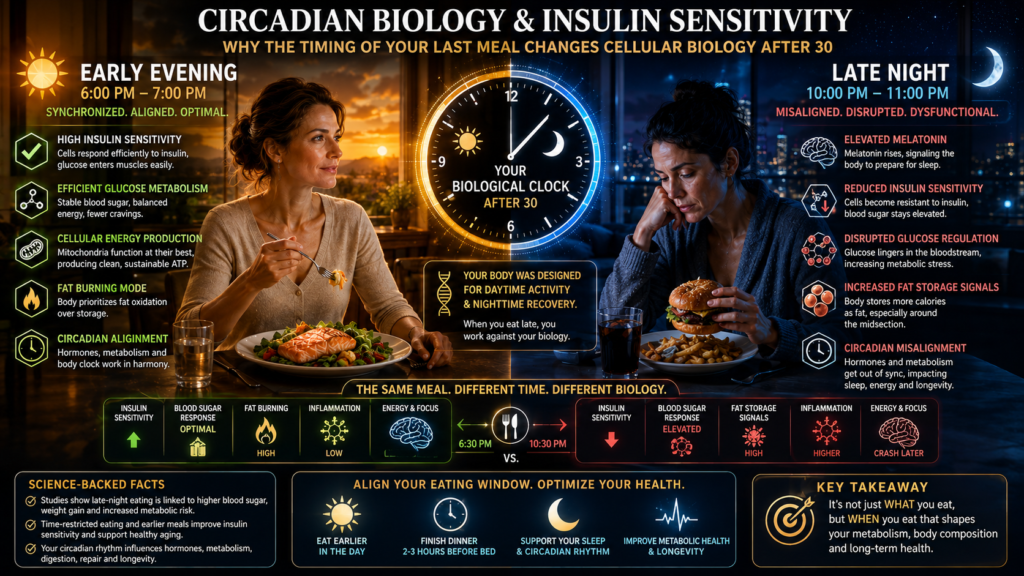
2.Why Insulin Sensitivity Changes Throughout the Day:
One of the most fascinating discoveries in chronobiology is that insulin sensitivity fluctuates naturally throughout the day.
In general:
- Insulin sensitivity tends to be highest in the morning.
- It gradually declines throughout the afternoon.
- It often reaches its lowest levels during late evening and nighttime hours.
This means the body typically handles glucose more efficiently earlier in the day.
When meals are consumed late at night, the pancreas may need to release more insulin to achieve the same glucose response.
Over time, repeatedly eating during periods of reduced insulin sensitivity may contribute to:
- Poor glucose regulation
- Increased fat storage
- Elevated fasting insulin
- Metabolic dysfunction
Researchers increasingly view meal timing as an important component of metabolic health.
3.The Role of Melatonin in Glucose Regulation:
Most people recognize melatonin as the sleep hormone.
However, melatonin influences much more than sleep.
As evening approaches, melatonin levels begin to rise.
This hormonal shift signals the body that nighttime recovery is approaching.
At the same time, several metabolic processes begin slowing down.
Research suggests that elevated melatonin levels may reduce the body’s ability to process glucose efficiently.
This creates an interesting biological conflict:
While many people consume their largest meals late in the evening, the body is simultaneously preparing for rest and repair rather than active nutrient processing.
This mismatch may contribute to impaired glucose control in susceptible individuals.
4.Why Late-Night Eating May Affect Fat Storage:
Late-night eating has become increasingly common in modern society.
Unfortunately, human biology evolved under very different conditions.
Historically:
- Light exposure decreased after sunset.
- Food intake naturally declined during nighttime hours.
- Repair and recovery processes dominated the evening period.
Today, artificial lighting, extended work schedules, and late dinners can shift eating patterns far beyond what our circadian systems evolved to handle.
Several studies suggest that consuming a large proportion of daily calories late in the evening may be associated with:
- Reduced fat oxidation
- Increased hunger signals
- Poorer glucose tolerance
- Greater risk of weight gain
While total calorie intake still matters, timing appears to influence how efficiently those calories are processed.
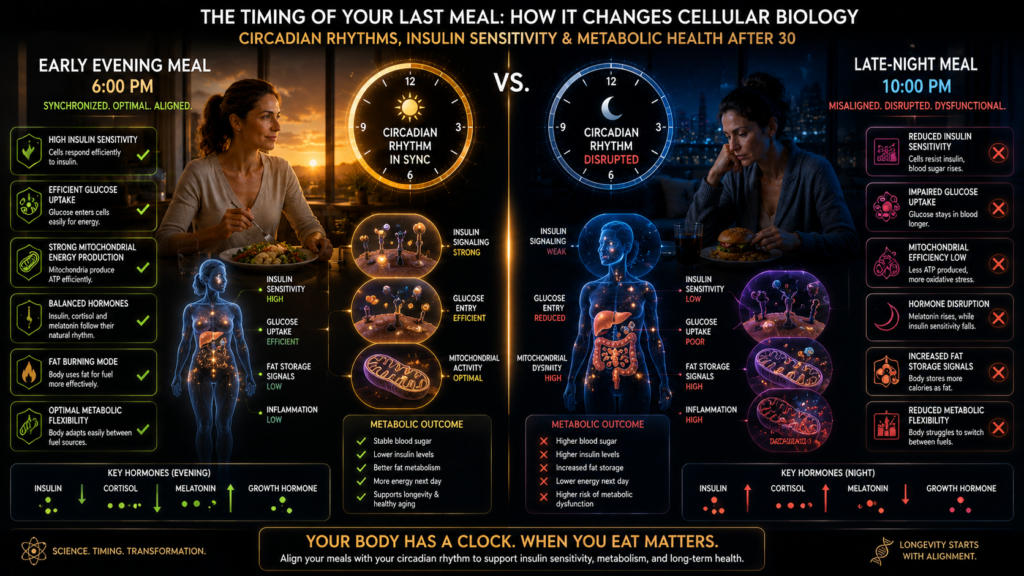
5.Circadian Misalignment and Metabolic Health:
Circadian misalignment occurs when behavioral patterns conflict with biological rhythms.
Examples include:
- Shift work
- Frequent jet lag
- Irregular sleep schedules
- Very late meals
- Chronic sleep deprivation
Over time, circadian disruption has been associated with:
- Insulin resistance
- Elevated inflammation
- Increased cortisol levels
- Weight gain
- Cardiometabolic risk
Researchers now consider circadian disruption one of the major environmental contributors to metabolic disease.
This does not mean occasional late dinners are harmful.
Rather, consistent patterns appear to matter most.
6.Time-Restricted Eating and Metabolic Flexibility:
One strategy receiving significant scientific attention is time-restricted eating (TRE).
TRE involves limiting daily food intake to a defined eating window.
Common examples include:
- 10-hour eating window
- 8-hour eating window
- Early time-restricted feeding
Importantly, TRE is not simply about reducing calories.
Its primary purpose is to align food intake with circadian biology.
Studies suggest that properly timed eating windows may support:
- Improved insulin sensitivity
- Better glucose control
- Enhanced metabolic flexibility
- Reduced fasting insulin levels
- Healthier body composition
For many adults over 30, meal timing may represent a practical tool for supporting metabolic resilience.
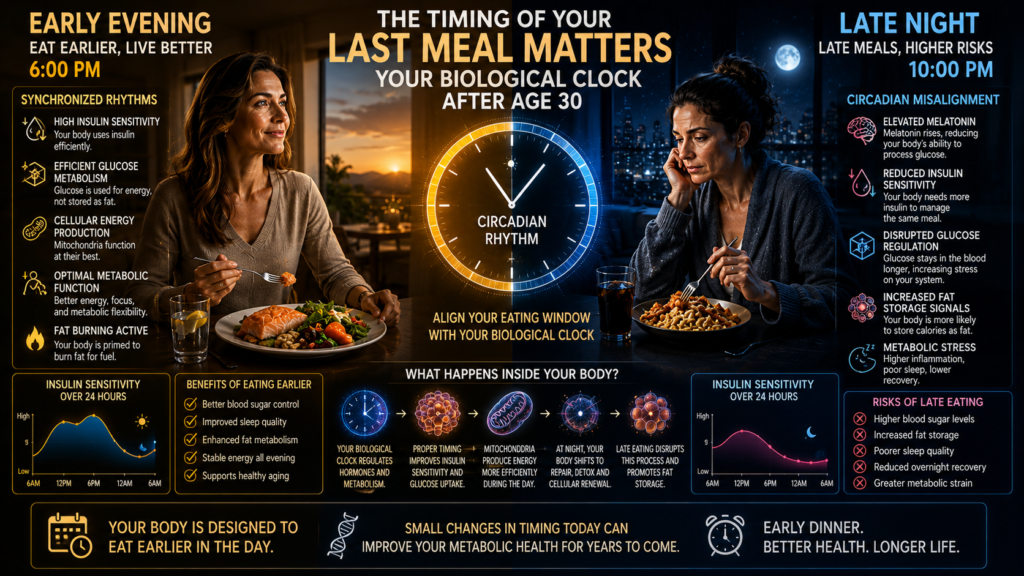
7.Mitochondria, Circadian Rhythms, and Energy Production:
Mitochondria generate the energy required for virtually every cellular process.
Researchers have discovered that mitochondrial activity follows circadian patterns.
When sleep schedules, meal timing, and light exposure remain synchronized, mitochondrial efficiency tends to improve.
Conversely, chronic circadian disruption may impair:
- ATP production
- Cellular energy generation
- Recovery capacity
- Metabolic flexibility
This helps explain why poor sleep and irregular meal schedules often contribute to fatigue and reduced physical performance.
8.Practical Strategies for Supporting Circadian Metabolism:
While perfect adherence is unrealistic, several evidence-based habits may help support circadian health:
Prioritize Consistent Sleep
Maintaining a regular sleep schedule helps synchronize biological clocks.
Avoid Large Meals Late at Night
Try to consume most daily calories earlier in the day when insulin sensitivity is naturally higher.
Seek Morning Light Exposure
Natural morning light helps reinforce circadian alignment.
Maintain Regular Meal Timing
Consistency appears to benefit metabolic regulation.
Support Mitochondrial Health
Physical activity, sleep quality, and nutrient-dense foods all contribute to cellular energy production.
Key Takeaways:
Circadian biology demonstrates that metabolism is not simply a matter of calories consumed versus calories burned.
The timing of food intake interacts with:
- Hormones
- Cellular energy systems
- Insulin sensitivity
- Sleep physiology
- Biological aging
For adults over 30, aligning eating habits with natural circadian rhythms may provide an additional tool for supporting metabolic health and longevity.
🧬 Support Healthy Cellular Energy
Healthy aging starts at the cellular level. Alongside proper nutrition, exercise, sleep, and stress management, some individuals choose targeted mitochondrial support to help maintain energy production and cellular vitality.
👉 Learn More About Advanced Mitochondrial Formula
Conclusion:
Modern longevity science increasingly recognizes that when we eat may be nearly as important as what we eat.
Circadian biology influences insulin sensitivity, glucose metabolism, mitochondrial function, and cellular repair mechanisms that support healthy aging.
By respecting the body’s natural rhythms, individuals may improve metabolic flexibility, support healthier blood sugar regulation, and enhance long-term vitality.
Small adjustments in meal timing today may contribute to meaningful improvements in metabolic health for years to come.
Medical Disclaimer & Affiliate Disclosure: This post contains affiliate links. If you choose to purchase any commercial biomarker testing kits, supplements, or products through these links, we may receive a small commission at no additional cost to you. We only recommend products aligned with our scientific reviews. The information on slimafter30s.com is for educational, scientific, and informational purposes only and does not substitute for professional medical advice, diagnosis, or treatment. Always consult with a qualified healthcare professional before making significant lifestyle changes, interpreting biomarkers, or beginning new nutritional protocols. Reliance on any information provided by Slim After 30s is solely at your own risk.