Optimize T3 and T4 weight loss after 30: For millions of adults over 30, weight loss begins to feel biologically impossible. Energy declines, body fat increases, motivation fades, and metabolism slows dramatically—even when blood work repeatedly comes back “normal.”
Many individuals leave medical appointments frustrated after being told:
“Your thyroid looks perfectly fine.”
Yet the symptoms persist:
- chronic fatigue;
- cold intolerance;
- stubborn weight gain;
- brain fog;
- hair thinning;
- and resistance to fat loss despite disciplined nutrition and exercise.
The problem is that conventional thyroid testing often evaluates only surface-level hormonal signaling rather than true cellular thyroid activity.
Modern endocrinology increasingly recognizes that metabolic dysfunction frequently develops long before standard laboratory markers fall outside traditional clinical reference ranges. In many cases, the issue is not whether thyroid hormone exists in the bloodstream—but whether active thyroid hormone is successfully reaching and activating the cells responsible for metabolic energy production.
After the age of 30, chronic stress, inflammation, gut dysfunction, micronutrient depletion, sleep disruption, and elevated cortisol progressively impair thyroid conversion pathways and cellular receptor sensitivity.
The result is a hidden metabolic slowdown that conventional testing frequently fails to detect.
1. The T4-to-T3 Conversion Crisis: Why “Normal” Thyroid Function Isn’t Enough:
The thyroid gland primarily produces Thyroxine (T4), an inactive storage hormone that functions more like a metabolic precursor than an active regulator.
For metabolism to operate efficiently, the body must convert T4 into Triiodothyronine (T3)—the biologically active thyroid hormone responsible for:
- mitochondrial respiration;
- thermogenesis;
- oxygen consumption;
- nervous system activation;
- and cellular energy output.
This conversion process occurs primarily in the liver, gut, kidneys, and peripheral tissues through specialized enzymes known as deiodinases.
However, after the age of 30, several modern lifestyle stressors begin impairing this conversion pathway:
- chronic psychological stress;
- gut dysbiosis;
- elevated cortisol;
- inflammatory signaling;
- micronutrient deficiencies;
- and sleep deprivation.
As deiodination efficiency declines, the body may continue producing “normal” levels of T4 while cellular T3 availability progressively falls.
This creates a dangerous metabolic illusion:
laboratory values appear acceptable,
while metabolism itself quietly slows down.
The consequence is reduced fat oxidation, lower mitochondrial activity, declining energy expenditure, and persistent resistance to weight loss.

2. Reverse T3: The Metabolic Brake System Most People Never Test:
One of the most overlooked drivers of metabolic slowdown is Reverse T3 (rT3), an inactive mirror-image thyroid hormone produced during periods of physiological stress.
Under healthy conditions, the body converts T4 into active T3 to sustain metabolic performance and energy production. However, during prolonged stress exposure, elevated cortisol and inflammatory signaling alter this conversion process dramatically.
Instead of generating active T3, the body increasingly converts T4 into Reverse T3 as part of an evolutionary survival mechanism designed to conserve energy during perceived threat or famine.
Reverse T3 acts as a biological brake system.
It binds directly to thyroid receptor sites without activating them, effectively blocking active T3 from entering the cell and performing its metabolic functions.
This creates a profound metabolic suppression state characterized by:
- chronic fatigue;
- reduced body temperature;
- brain fog;
- exercise intolerance;
- stubborn visceral fat accumulation;
- and impaired fat oxidation.
From an evolutionary perspective, this mechanism once protected humans during periods of starvation. In modern society, however, chronic occupational stress, sleep deprivation, overtraining, and inflammatory lifestyles continuously activate this metabolic defense response.
The body becomes biologically trapped in energy conservation mode.
3. Why Standard Thyroid Testing Frequently Misses the Real Problem:
Optimize T3 and T4 weight loss after 30: Most standard medical evaluations rely heavily on Thyroid-Stimulating Hormone (TSH) testing alone.
However, TSH is not a thyroid hormone—it is a pituitary signaling hormone designed to communicate with the thyroid gland itself. While useful for identifying severe thyroid dysfunction, TSH alone provides very limited insight into:
- peripheral thyroid conversion;
- cellular receptor activity;
- Reverse T3 dominance;
- or active tissue-level thyroid function.
This is why many individuals continue experiencing metabolic symptoms despite receiving “normal” laboratory results.
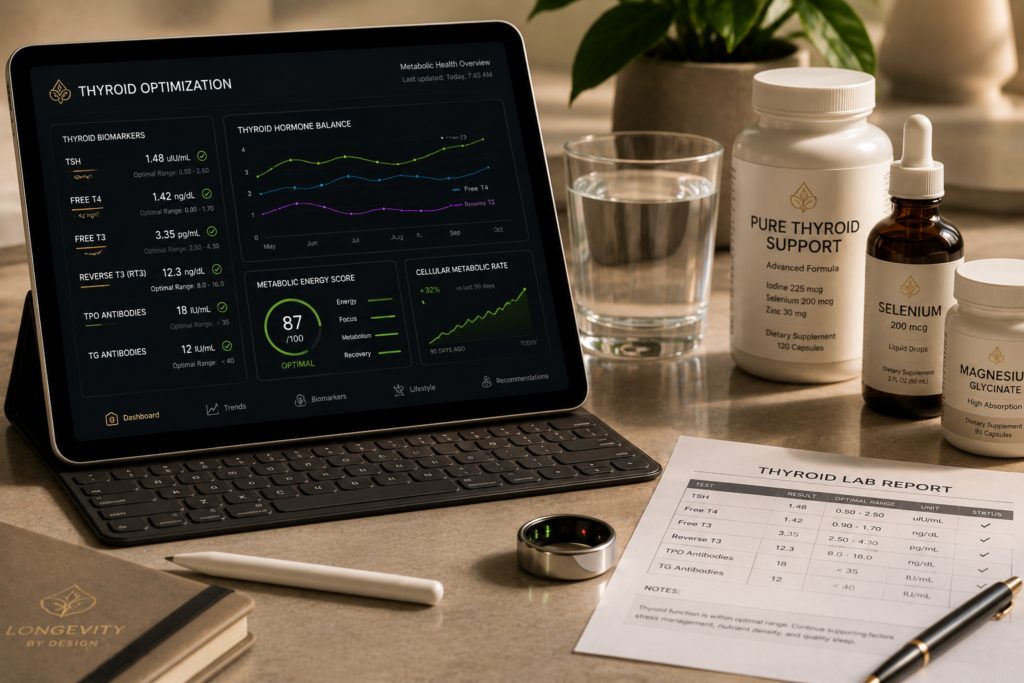
A comprehensive functional assessment of thyroid optimization should include:
- TSH;
- Free T4;
- Free T3;
- Reverse T3;
- Thyroid Peroxidase Antibodies (TPO);
- and Thyroglobulin Antibodies (TgAb).
This broader hormonal analysis provides a far more accurate picture of:
- thyroid conversion efficiency;
- autoimmune thyroid activity;
- cellular thyroid signaling;
- and metabolic adaptability.
Optimal metabolic performance depends not simply on hormone presence—but on efficient hormone activation and receptor utilization.
4. Nutritional Biohacking for Thyroid Optimization and Fat Oxidation:
Efficient thyroid function depends heavily on precise micronutrient availability and cellular metabolic support.
The enzymes responsible for converting T4 into active T3 require specific nutritional cofactors to function properly. Without these substrates, thyroid conversion efficiency gradually deteriorates.
Among the most critical nutrients involved in thyroid optimization are:
- selenium;
- zinc;
- iodine;
- magnesium;
- tyrosine;
- and vitamin D3.
Selenium is particularly important because it directly supports deiodinase enzyme activity while simultaneously protecting thyroid tissue from oxidative stress.
Likewise, zinc and magnesium contribute to receptor sensitivity, mitochondrial energy production, and hormonal signaling efficiency.
Emerging research also suggests that gut microbiome health plays a major role in thyroid regulation. Approximately 20% of peripheral T4-to-T3 conversion may occur through gut-mediated mechanisms influenced by bacterial diversity and inflammatory balance.
This means metabolic optimization after 30 requires supporting not only the thyroid gland itself, but the entire interconnected endocrine ecosystem surrounding it.
True thyroid optimization is ultimately a systems biology process—not a single hormone problem.
Conclusion:
After the age of 30, unexplained weight gain and metabolic slowdown are frequently rooted in hidden thyroid conversion dysfunction rather than simple caloric imbalance alone.
The modern metabolic crisis often develops not because thyroid hormone is absent, but because active thyroid signaling becomes disrupted at the cellular level through chronic stress, inflammation, micronutrient depletion, gut dysfunction, and elevated Reverse T3 activity.
This explains why many individuals continue feeling metabolically exhausted despite receiving “normal” laboratory results.
Sustainable fat loss requires looking beyond simplified testing models and understanding the deeper biological architecture controlling energy production itself.
When T4-to-T3 conversion improves, mitochondrial function strengthens, inflammatory burden decreases, and cellular thyroid signaling becomes optimized once again, the body gradually exits metabolic conservation mode and reactivates efficient fat oxidation.
Your metabolism does not simply depend on hormones existing in the bloodstream—it depends on those hormones successfully reaching and energizing the cells responsible for life itself.
Medical Disclaimer: The information on this website is for educational and informational purposes only and is not intended as medical advice. The content regarding thyroid hormones, T3, T4, Reverse T3, thyroid optimization, endocrine physiology, and metabolic health is based on current scientific research but should not be used to diagnose, treat, or prevent any health condition. Always consult with a qualified healthcare professional or physician before implementing supplementation protocols or interpreting laboratory results. Reliance on any information provided by slimafter30s.com is solely at your own risk.
Pingback: Crash diet muscle loss after 30