Cortisol and Abdominal Fat after 30: For many high-performing professionals, abdominal fat after 30 becomes deeply confusing. Discipline remains intact, workouts continue, nutrition improves—yet the waistline expands anyway. Despite following the same strategies that once maintained a lean physique in their twenties, the body suddenly begins storing stubborn belly fat that appears highly resistant to traditional dieting and exercise.
This phenomenon is not simply a matter of aging or reduced willpower. It is a sophisticated neuroendocrine adaptation driven by chronic occupational stress and prolonged cortisol exposure.
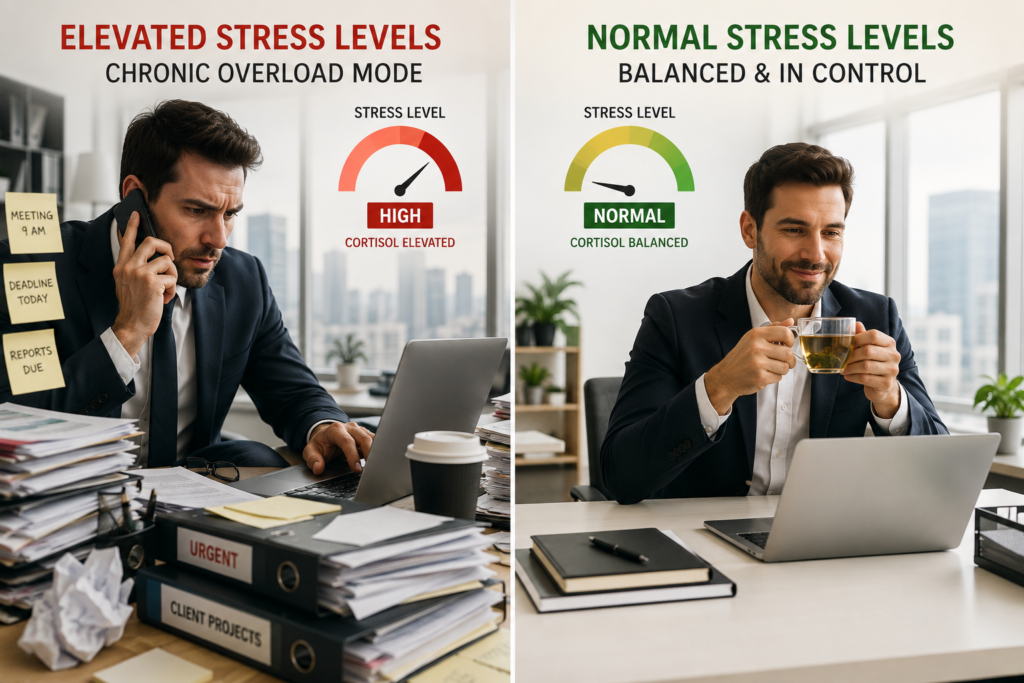
In the modern corporate environment, the nervous system rarely experiences true recovery. Constant notifications, psychological pressure, multitasking, sleep disruption, and continuous cognitive stimulation keep the brain trapped in a persistent state of low-grade survival physiology. Over time, this chronic activation fundamentally alters hormonal signaling pathways responsible for metabolism, appetite regulation, thyroid activity, and fat storage.
After the age of 30, elevated cortisol no longer acts merely as an acute stress hormone—it begins reshaping metabolic architecture itself. The body increasingly prioritizes energy conservation, insulin resistance rises, thyroid efficiency declines, and visceral fat accumulation accelerates around the abdominal organs.
The result is a metabolic state where the body appears to work against the individual despite consistent effort.
1. Why Cortisol Selectively Targets Abdominal Fat:
From a biological perspective, visceral belly fat is not random—it is hormonally strategic.
Unlike subcutaneous fat located beneath the skin, visceral adipose tissue surrounding the abdominal organs possesses an exceptionally high concentration of glucocorticoid receptors, making it uniquely sensitive to circulating cortisol levels.
When occupational stress becomes chronic, cortisol repeatedly binds to these receptors and triggers a cascade of metabolic adaptations designed for survival. Under these conditions, the body preferentially redirects circulating triglycerides and excess glucose toward abdominal storage sites where energy can be rapidly mobilized during future stress exposure. This mechanism once protected humans during famine and environmental threat. However, in modern society, psychological stressors activate the exact same survival circuitry despite the absence of true physical danger.
The consequence is a highly localized pattern of fat accumulation characterized by:
- increased waist circumference;
- visceral organ fat deposition;
- elevated inflammatory signaling;
- and worsening insulin resistance.
This is one reason why chronic stress often changes body composition even when overall caloric intake appears relatively controlled.
2. HPA-Axis Dysregulation and the Metabolic Shutdown Effect:
As stress exposure becomes persistent, the Hypothalamic-Pituitary-Adrenal (HPA) axis gradually loses its normal rhythmic regulation.
Under healthy conditions, cortisol follows a tightly controlled circadian curve—rising naturally in the morning to promote alertness and gradually declining throughout the evening to allow recovery and sleep initiation. Chronic occupational stress disrupts this biological rhythm entirely.
Once the HPA-axis becomes dysregulated, the downstream effects extend directly into thyroid physiology and mitochondrial energy production.
Elevated cortisol actively suppresses the enzymatic conversion of inactive thyroid hormone (T4) into Triiodothyronine (T3), the metabolically active thyroid hormone responsible for:
- mitochondrial respiration;
- thermogenesis;
- cellular oxygen consumption;
- and resting metabolic rate.
Instead, the body increasingly converts T4 into Reverse T3 (rT3), an inactive isomer that competes with active thyroid receptors and essentially slows metabolic output as a protective adaptation.
This physiological slowdown creates what many individuals experience as:
- unexplained fatigue;
- poor exercise recovery;
- cold intolerance;
- brain fog;
- and stubborn resistance to fat loss.
The body is not “broken”—it is prioritizing survival over metabolic performance.
3. Neuropeptide Y: The Neurochemical Driver of Stress Eating:
Neurochemical Driver of Stress Eating
One of the most underestimated effects of chronic cortisol elevation is its direct influence on appetite neurochemistry.
During prolonged stress exposure, the brain increases production of Neuropeptide Y (NPY), a highly potent orexigenic signaling molecule strongly associated with survival feeding behavior.
NPY dramatically increases cravings for:
- sugar;
- hyper-palatable carbohydrates;
- high-fat comfort foods;
- and calorie-dense meals capable of rapidly restoring perceived energy deficits.
From an evolutionary standpoint, this adaptation was biologically advantageous during periods of starvation or environmental uncertainty. In modern society, however, persistent occupational stress keeps this appetite circuitry continuously activated despite caloric abundance.
Simultaneously, cortisol amplifies dopaminergic reward sensitivity inside the mesolimbic pathway, making processed foods neurologically more pleasurable during stressful periods.
This creates a destructive biochemical loop:
- stress increases cortisol;
- cortisol increases NPY;
- NPY intensifies cravings;
- cravings drive overconsumption;
- and overconsumption reinforces visceral fat accumulation.
What many individuals interpret as “lack of discipline” is often an advanced neurochemical survival mechanism operating beneath conscious awareness.
4. Biohacking the Nervous System for Metabolic Recovery:
Sustainable fat loss after 30 requires more than calorie control—it requires restoring safety signals to the nervous system.
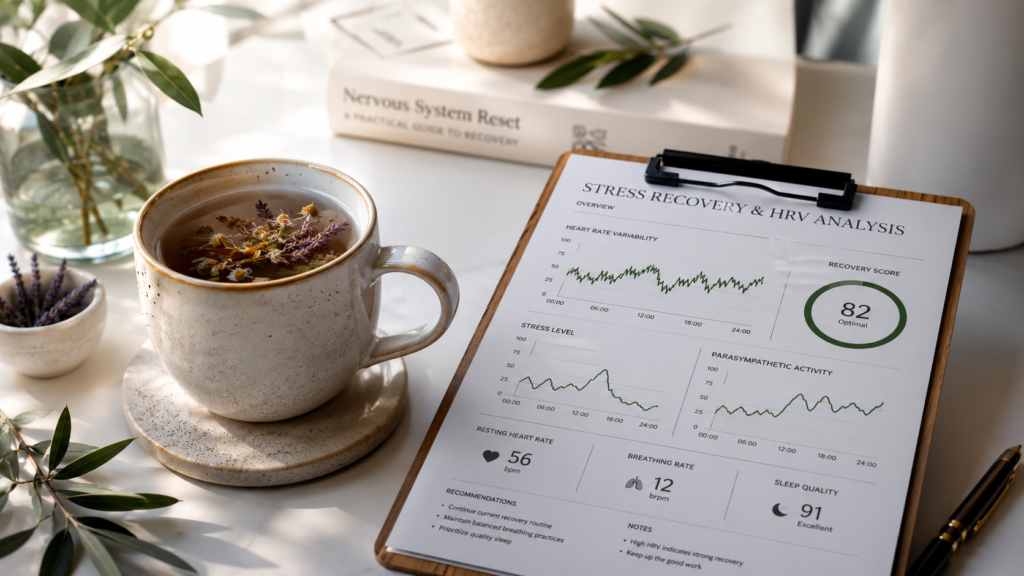
The goal is not eliminating stress completely, but improving autonomic flexibility and reducing chronic sympathetic dominance. Small evidence-based interventions integrated throughout the day can significantly lower systemic cortisol burden and restore metabolic resilience.
Among the most effective nervous-system recovery strategies are:
- Non-Sleep Deep Rest (NSDR) protocols;
- physiological sigh breathing;
- morning sunlight exposure;
- circadian sleep stabilization;
- and strategic digital decompression periods.
Morning sunlight exposure is particularly powerful because it anchors the suprachiasmatic nucleus—the brain’s master circadian clock—helping normalize cortisol timing and improve melatonin release later in the evening.
Likewise, physiological sigh breathing (two rapid nasal inhales followed by one extended exhale) rapidly activates parasympathetic vagal pathways capable of lowering heart rate and reducing acute stress arousal within minutes.
These micro-recovery protocols gradually shift the body away from chronic defense physiology and back toward metabolic flexibility, hormonal balance, and efficient fat oxidation.
Conclusion:
“Cortisol and abdominal fat after 30”. After the age of 30, belly fat is often less about calories and more about neuroendocrine survival signaling.
Chronic occupational stress fundamentally reshapes metabolism by altering cortisol rhythms, suppressing thyroid efficiency, increasing inflammatory signaling, and rewiring appetite neurochemistry. Over time, the body becomes biologically conditioned to preserve energy and store visceral fat as a protective adaptation.
This is why traditional dieting strategies frequently fail under chronic stress conditions.
True metabolic recovery requires regulating the microscopic hormonal environment controlling fat storage itself. By restoring circadian balance, calming the nervous system, improving vagal tone, and reducing chronic cortisol exposure, the body gradually exits survival mode and reactivates efficient fat metabolism.
Sustainable weight loss begins when your physiology finally feels safe enough to stop defending itself.
Medical Disclaimer: The information on this website is for educational and informational purposes only and is not intended as medical advice. The content regarding cortisol physiology, occupational stress, HPA-axis dysfunction, thyroid signaling, neurochemistry, visceral fat accumulation, and metabolic health is based on current scientific research but should not be used to diagnose, treat, or prevent any health condition. Always consult with a qualified healthcare professional or physician before implementing new stress-management protocols, supplementation strategies, or metabolic interventions. Reliance on any information provided by slimafter30s.com is solely at your own risk.
Pingback: Metabolic Flexibility After 30: Why Your Body Stops Burning Fat Efficiently
Pingback: Optimize T3 and T4 weight loss after 30