“Protein distribution metabolism after 30“: For decades, weight-loss culture has treated protein intake as a simple numbers game: hit a daily target, consume enough grams, and the body will automatically preserve muscle and burn fat efficiently. However, emerging metabolic research suggests that after the age of 30, total protein intake becomes only part of the equation.
What truly determines metabolic resilience is how protein is distributed throughout the day.
As the body ages, skeletal muscle gradually develops a phenomenon known as anabolic resistance—a reduced sensitivity to the muscle-building signals generated by dietary amino acids. This biological shift means that randomly consuming protein or concentrating the majority of intake at dinner becomes metabolically inefficient.
The consequence is subtle but profound:
- muscle protein synthesis declines;
- resting metabolic rate decreases;
- glucose disposal worsens;
- and fat accumulation accelerates.
This process contributes directly to what researchers now describe as sarcopenic obesity—a metabolic condition characterized by declining lean muscle mass combined with increasing fat storage despite stable body weight.
To optimize metabolism after 30, protein must be strategically timed, evenly distributed, and biologically synchronized with circadian physiology, muscle signaling pathways, and recovery cycles.
1. Anabolic Resistance: Why Aging Muscles Require Strategic Protein Timing:
Beginning in the third decade of life, skeletal muscle tissue gradually becomes less responsive to anabolic stimulation from dietary amino acids. This phenomenon, known clinically as anabolic resistance, represents one of the most overlooked drivers of metabolic slowdown after 30.
Protein Distribution Metabolism After 30. In younger individuals, relatively small amounts of protein efficiently stimulate Muscle Protein Synthesis (MPS). However, aging muscle requires significantly stronger amino acid signaling to activate the same metabolic response.
This occurs primarily because aging muscle tissue exhibits:
- reduced mTOR sensitivity;
- impaired amino acid transport efficiency;
- decreased mitochondrial responsiveness;
- and diminished satellite cell activation.
As a result, consuming insufficient protein at individual meals creates prolonged periods where muscle tissue remains under-stimulated, accelerating:
- lean tissue decline;
- insulin resistance;
- reduced thermogenesis;
- and lower resting caloric expenditure.
This explains why many individuals experience worsening body composition after 30 despite maintaining relatively stable caloric intake.
The problem is often not calories—it is insufficient anabolic signaling frequency.

2. The Leucine Threshold and Muscle Protein Synthesis Activation:
Among all amino acids involved in muscle metabolism, leucine functions as the primary anabolic trigger responsible for activating mTORC1—the master regulator of muscle protein synthesis.
Research suggests that most adults require approximately 2.5 to 3 grams of leucine per meal to fully stimulate MPS after the age of 30. This threshold becomes increasingly important as anabolic resistance progresses with age.
Meals low in high-quality protein may provide calories without adequately activating muscle-building pathways, leading to what metabolic researchers often describe as “underfed muscle physiology.”
This creates a dangerous metabolic paradox:
- caloric intake remains elevated;
- but lean tissue preservation steadily declines.
Strategically distributing protein across multiple meals ensures repeated stimulation of anabolic pathways throughout the day rather than relying on one excessively protein-heavy evening meal.
High-biological-value protein sources particularly effective at reaching the leucine threshold include:
- eggs;
- Greek yogurt;
- whey protein;
- salmon;
- poultry;
- and lean grass-fed meats.
When consistently distributed throughout the day, these proteins help maintain:
- muscle integrity;
- mitochondrial density;
- glucose uptake efficiency;
- and long-term metabolic flexibility.
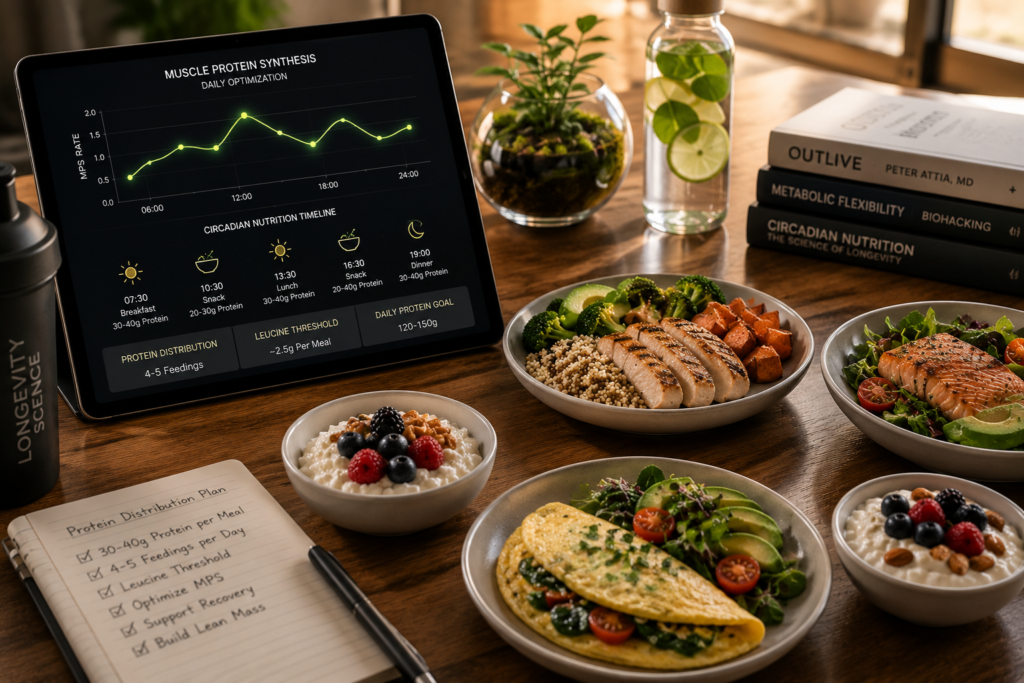
3. Circadian Protein Timing and Metabolic Synchronization:
Human metabolism follows a tightly regulated circadian rhythm controlled by both the central nervous system and peripheral metabolic clocks located throughout the body.
Emerging chrononutrition research demonstrates that protein metabolism itself is profoundly influenced by circadian timing.
Insulin sensitivity, amino acid utilization, digestive efficiency, and muscle glucose uptake are all significantly higher earlier in the day compared to late-night feeding windows. This means that identical meals can produce dramatically different metabolic outcomes depending on timing.
Front-loading protein intake during breakfast and lunch appears particularly beneficial for:
- preserving lean tissue;
- stabilizing blood glucose;
- reducing cravings;
- and improving satiety signaling.
Conversely, consuming the majority of daily protein intake late at night may impair circadian synchronization and reduce anabolic efficiency.
This concept—known as metabolic synchronization—suggests that aligning protein intake with biological rhythms optimizes:
- nutrient partitioning;
- mitochondrial function;
- hormonal signaling;
- and body composition regulation.
In practical terms, your metabolism is not only influenced by what you eat, but also by when your cells are biologically prepared to process those nutrients most efficiently.
4. Protein Pulsing, Thermogenesis, and Fat Loss Efficiency:
Protein possesses the highest Thermic Effect of Food (TEF) of all macronutrients, meaning the body expends significantly more energy digesting and metabolizing protein compared to fats or carbohydrates.
Protein Distribution Metabolism After 30: approximately 20–30% of protein calories may be burned during digestion itself.
However, this thermogenic advantage becomes even more pronounced when protein intake is distributed strategically throughout the day in what researchers describe as protein pulsing.
Rather than consuming minimal protein during daylight hours followed by one large evening meal, protein pulsing creates repeated thermogenic and anabolic stimulation cycles capable of:
- preserving lean tissue;
- increasing satiety;
- stabilizing blood sugar;
- and improving total daily energy expenditure.
Additionally, stable protein distribution helps suppress excessive ghrelin fluctuations while improving production of satiety hormones such as:
- GLP-1;
- Peptide YY (PYY);
- and cholecystokinin (CCK).
This hormonal stabilization dramatically reduces:
- impulsive snacking;
- late-night overeating;
- and stress-driven cravings.
Sustainable fat loss after 30 depends not merely on calorie restriction, but on preserving the metabolically expensive tissue that governs energy expenditure itself: skeletal muscle.
Conclusion:
After the age of 30, metabolism becomes increasingly dependent on muscle preservation, circadian alignment, and strategic nutrient timing rather than simple caloric mathematics alone.
The Effect represents a fundamental shift in how modern metabolic science understands body composition regulation. Total protein intake remains important—but timing, frequency, leucine activation thresholds, and circadian synchronization may be even more critical for maintaining metabolic flexibility and lean tissue preservation.
When protein intake is intelligently distributed throughout the day, the body receives repeated anabolic signals that preserve skeletal muscle, stabilize appetite hormones, improve glucose metabolism, and sustain higher resting energy expenditure. Long-term fat loss is not achieved by starving the body—it is achieved by feeding muscle tissue at the precise moments biology is prepared to use those nutrients most efficiently.
“Medical Disclaimer: The information on this website is for educational and informational purposes only and is not intended as medical advice. The content regarding muscle protein synthesis, anabolic resistance, leucine thresholds, circadian nutrition, metabolic synchronization, and protein timing is based on current scientific research but should not be used to diagnose, treat, or prevent any health condition. Always consult with a qualified healthcare professional or physician before making significant dietary changes or beginning new nutritional protocols. Reliance on any information provided by slimafter30s.com is solely at your own risk.”
Pingback: The Glucose Insulin Connection: How Metabolic Synchronization Leads to Effortless Fat Loss