As we age, most conversations about longevity focus on hormones, exercise, nutrition, or weight management. Yet one of the most important drivers of healthy aging operates at a microscopic level inside every cell of the human body.
Urolithin A and Mitophagy
Your mitochondria.
Often referred to as the “powerhouses of the cell,” mitochondria are responsible for producing the energy required for movement, metabolism, cognitive function, recovery, and virtually every biological process associated with vitality.
The challenge is that after the age of 30, mitochondrial efficiency gradually declines. Damaged mitochondria begin to accumulate, cellular energy production becomes less efficient, and the body’s ability to repair itself slowly deteriorates.
Scientists now believe that one of the keys to healthy aging is not simply creating new mitochondria, but removing old dysfunctional ones.
This process is called mitophagy.
And one of the most fascinating compounds ever discovered to support this process is Urolithin A.

1.The Hidden Problem Inside Aging Muscle Cells:
Most people notice aging through visible changes:
- Reduced strength
- Slower recovery
- Lower energy levels
- Increased body fat
- Reduced exercise capacity
However, these symptoms often begin at the cellular level long before they become obvious.
Within aging muscle tissue, damaged mitochondria accumulate over time. These dysfunctional cellular structures produce less energy while simultaneously generating higher levels of oxidative stress.
The result is a gradual decline in muscle quality, metabolic flexibility, and physical resilience.
This phenomenon is now considered one of the hallmarks of biological aging.
2.Why Your Body Stops Recycling Damaged Mitochondria:
The human body possesses an extraordinary quality-control system.
When cells detect damaged components, they can recycle them through a process known as autophagy.
Mitophagy is a specialized form of autophagy that specifically targets defective mitochondria.
Think of mitophagy as a cellular cleanup crew.
Its role is simple:
- Identify damaged mitochondria
- Remove them safely
- Make room for healthier replacements
Unfortunately, mitophagy becomes less efficient with age.
As this process slows, defective mitochondria accumulate inside muscle tissue, reducing energy production and contributing to age-related decline.
3.What Is Urolithin A?
Urolithin A is a natural metabolite produced by specific gut bacteria.
It originates from compounds known as ellagitannins, which are found in:
- Pomegranates
- Walnuts
- Pecans
- Strawberries
- Raspberries
Interestingly, consuming these foods does not guarantee Urolithin A production.
Only individuals who possess the appropriate gut microbial composition can efficiently convert ellagitannins into Urolithin A.
This explains why two people can eat the same foods yet generate dramatically different biological responses.
The gut microbiome plays a crucial role in determining whether this longevity compound is produced.
4.The Science of Mitophagy and Cellular Renewal:
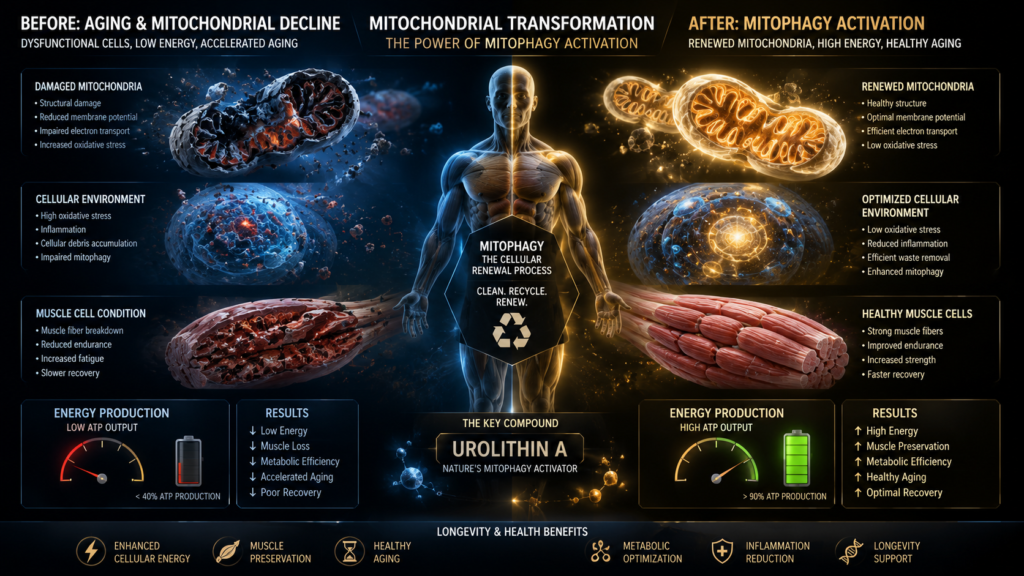
What makes Urolithin A so exciting is its ability to activate pathways involved in mitochondrial recycling.
Preclinical and human studies suggest that Urolithin A may help:
- Improve mitochondrial function
- Support muscle endurance
- Enhance cellular energy production
- Promote mitochondrial quality control
- Support healthy aging processes
By stimulating mitophagy, Urolithin A helps the body remove damaged cellular energy generators and replace them with healthier, more efficient ones.
Rather than masking symptoms, it addresses one of the underlying biological mechanisms associated with aging.
5.Human Clinical Trials and Muscle Function:
The scientific interest surrounding Urolithin A increased dramatically when human trials began demonstrating measurable improvements in markers associated with mitochondrial health.
Several studies have reported improvements in:
- Muscle endurance
- Cellular energy pathways
- Mitochondrial biomarkers
- Physical performance indicators
Researchers observed that participants receiving Urolithin A supplementation demonstrated molecular changes consistent with enhanced mitochondrial renewal.
These findings are particularly important because skeletal muscle is highly dependent on efficient energy production.
As mitochondrial function improves, muscles become better equipped to maintain performance and recovery capacity.
6.Why Urolithin A Has Become a Biohacking Favorite:
The biohacking community quickly embraced Urolithin A because it targets one of the most fundamental mechanisms of aging.
Unlike many supplements that focus on symptoms, Urolithin A operates at the cellular level.
This aligns perfectly with the modern longevity approach:
Instead of asking:
“How do I feel younger?”
Researchers ask:
“How do we preserve cellular function for longer?”
The answer increasingly points toward mitochondrial health.
This is why Urolithin A has gained attention among longevity physicians, performance specialists, and healthy-aging researchers.
7.Can You Increase Urolithin A Naturally?
Theoretically, yes.
Increasing intake of ellagitannin-rich foods may support natural Urolithin A production.
Examples include:
- Pomegranate
- Walnuts
- Pecans
- Berries
However, there is a significant limitation.
Because Urolithin A production depends heavily on gut microbial composition, many individuals produce little or none at all.
This highlights the growing importance of gut health and microbiome diversity. The healthier and more diverse the microbiome, the greater the likelihood of producing beneficial metabolites that support longevity.
8.The Connection Between Urolithin A, Muscle Preservation, and Longevity:
One of the greatest threats to healthy aging is sarcopenia—the gradual loss of muscle mass and function.
Muscle tissue is not merely important for movement.
It plays a central role in:
- Glucose regulation
- Metabolic health
- Insulin sensitivity
- Physical independence
- Longevity
By enhancing mitophagy, Urolithin A may contribute to maintaining stronger, healthier muscle cells for longer periods of time.
This makes it particularly relevant for adults over 30 who want to protect both metabolic health and physical performance.
9.Practical Takeaways:
If you are interested in healthy aging and metabolic longevity:
- Prioritize mitochondrial health.
- Consume polyphenol-rich foods regularly.
- Support microbiome diversity through fiber intake.
- Engage in regular physical activity.
- Focus on preserving muscle mass as you age.
- Stay informed about emerging longevity science.
Urolithin A represents one of the most promising developments in the field of cellular health because it addresses a fundamental biological process rather than merely treating symptoms.
🧬 Support Healthy Cellular Energy
Healthy aging starts at the cellular level. Alongside proper nutrition, exercise, sleep, and stress management, some individuals choose targeted mitochondrial support to help maintain energy production and cellular vitality.
👉 Learn More About Advanced Mitochondrial Formula
Conclusion:
Longevity is no longer viewed simply as living longer.
Modern longevity science focuses on preserving function, strength, energy, and resilience throughout life.
Mitophagy sits at the center of this conversation.
By helping the body recycle damaged mitochondria, Urolithin A may support one of the most important cellular renewal systems involved in healthy aging.
While research continues to evolve, the evidence already suggests that mitochondrial quality control may become one of the defining pillars of longevity medicine in the decades ahead.
For adults over 30, understanding and supporting cellular energy production may be one of the smartest investments in future health.
Medical Disclaimer & Affiliate Disclosure: This post contains affiliate links. If you choose to purchase any commercial biomarker testing kits, supplements, or products through these links, we may receive a small commission at no additional cost to you. We only recommend products aligned with our scientific reviews. The information on slimafter30s.com is for educational, scientific, and informational purposes only and does not substitute for professional medical advice, diagnosis, or treatment. Always consult with a qualified healthcare professional before making significant lifestyle changes, interpreting biomarkers, or beginning new nutritional protocols. Reliance on any information provided by Slim After 30s is solely at your own risk.