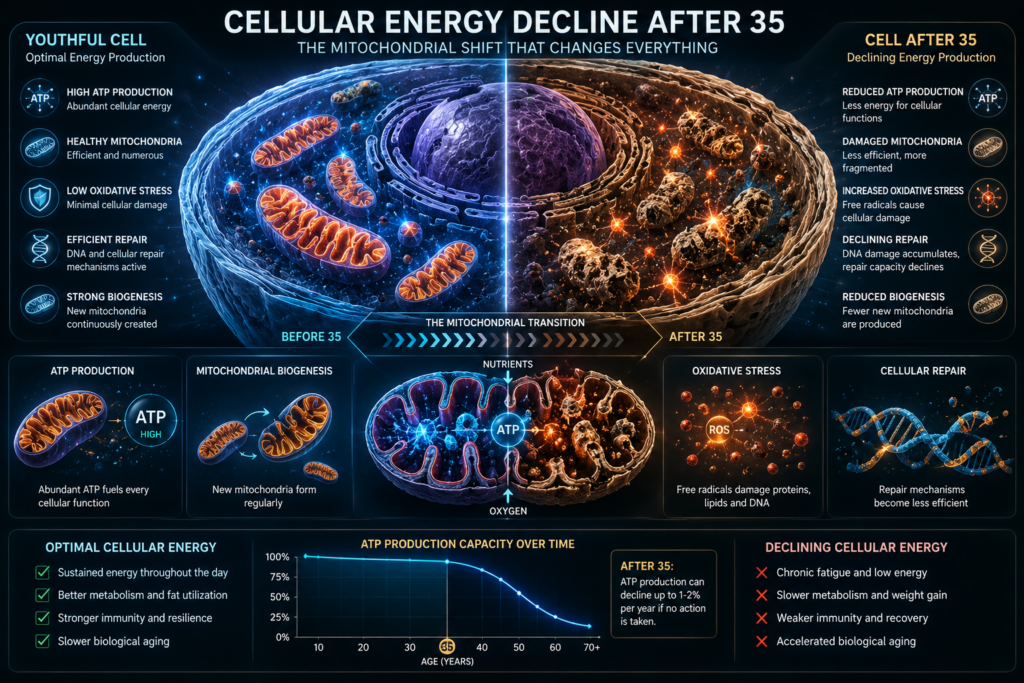
Cellular Energy Decline After 35: Many adults notice a subtle but persistent shift in their energy levels beginning in their mid-thirties. Tasks that once felt effortless become more demanding. Recovery from exercise takes longer. Mental clarity fluctuates. Fat accumulation becomes easier, while maintaining physical performance requires significantly more effort.
Most people assume these changes are simply part of aging.
However, modern longevity science suggests something far more specific is occurring beneath the surface.
The primary driver of this gradual decline is often not chronological age itself, but a progressive reduction in mitochondrial efficiency.
Mitochondria are microscopic organelles found inside nearly every cell of the human body. Frequently described as the cell’s power plants, they convert nutrients and oxygen into adenosine triphosphate (ATP), the biological currency that fuels virtually every physiological process.
As mitochondrial performance declines, cellular energy production becomes less efficient, initiating a cascade of metabolic adaptations that influence fatigue, body composition, cognitive performance, and biological aging.
Understanding why this happens is essential for anyone seeking to maintain vitality beyond the age of 35.
1.The Critical Role of Mitochondria in Human Energy Production:
Every heartbeat, muscle contraction, thought, and repair process requires ATP.
Mitochondria generate approximately 90% of the body’s usable cellular energy through oxidative phosphorylation.
The process begins when nutrients derived from food are broken down into smaller molecules. These molecules enter the mitochondria, where a sophisticated biochemical system extracts electrons and converts their energy into ATP.
When mitochondrial function is optimal:
- Energy levels remain stable
- Metabolic flexibility improves
- Recovery is efficient
- Cognitive performance remains sharp
- Fat oxidation is enhanced
When mitochondrial performance declines, these processes begin to deteriorate simultaneously.

2.Why Cellular Energy Production Begins Declining After 35:
The decline is not caused by a single factor.
Instead, several interconnected biological mechanisms gradually reduce mitochondrial performance.
1. Accumulated Oxidative Stress
Mitochondria continuously generate reactive oxygen species (ROS) during energy production.
In moderate amounts, ROS serve important signaling functions.
Over time, however, excessive oxidative stress can damage:
- Mitochondrial DNA
- Cellular membranes
- Energy-producing enzymes
- Electron transport chain proteins
This damage reduces ATP production efficiency and accelerates cellular aging.
2. Reduced Mitochondrial Biogenesis
Mitochondrial biogenesis refers to the creation of new mitochondria.
This process is regulated by cellular pathways involving:
- PGC-1α
- AMPK
- SIRT1
After age 35, these signaling pathways often become less responsive due to sedentary behavior, chronic inflammation, poor sleep quality, and metabolic dysfunction.
As a result, cells produce fewer healthy mitochondria.
3. Chronic Low-Grade Inflammation
Researchers often refer to age-related inflammation as “inflammaging.”
Even modest increases in inflammatory signaling can interfere with mitochondrial function.
Inflammation reduces metabolic efficiency by:
- Increasing oxidative stress
- Impairing insulin sensitivity
- Disrupting cellular repair mechanisms
- Accelerating mitochondrial deterioration
4. Declining Cellular Repair Mechanisms
Healthy cells constantly recycle damaged components through autophagy and mitophagy.
Mitophagy specifically removes dysfunctional mitochondria.
As these quality-control systems become less efficient with age, damaged mitochondria accumulate, reducing overall cellular energy production.
3.How Mitochondrial Dysfunction Affects Everyday Life:
The consequences extend far beyond feeling tired.
Reduced ATP availability limits the body’s capacity to meet daily energy demands.
Slower Exercise Recovery
Muscle repair and adaptation require substantial cellular energy.
Lower mitochondrial efficiency often results in prolonged recovery times.
Increased Fat Accumulation
Mitochondria are central to fat oxidation.
When energy production becomes inefficient, metabolic flexibility declines and fat storage becomes more likely.
Brain Fog and Reduced Cognitive Performance
The brain consumes enormous quantities of ATP.
Even modest reductions in mitochondrial function can affect concentration, memory, and mental clarity.
4.The Connection Between Mitochondrial Health and Longevity:
One of the strongest predictors of healthy aging is mitochondrial resilience.
Scientists studying centenarians frequently observe:
- Better mitochondrial preservation
- Lower oxidative stress
- Improved metabolic flexibility
- More efficient cellular repair pathways
This suggests that maintaining mitochondrial function may significantly influence biological aging itself. Related reading:
Cellular Aging After 30: The Invisible Process Affecting Your Weight and Energy

5.Evidence-Based Strategies to Support Mitochondrial Function:
Prioritize Zone 2 Cardio Training
Zone 2 exercise stimulates mitochondrial biogenesis and improves oxygen utilization.
Related reading:
Zone 2 Cardio and Metabolic Longevity: Why VO₂ Max Dictates Your Fat-Burning Potential After 30
Optimize Sleep Quality
Deep sleep supports mitochondrial repair, hormone regulation, and cellular recovery.
Increase Protein Intake
Adequate protein provides amino acids necessary for tissue maintenance and cellular regeneration.
Manage Circadian Rhythms
Consistent sleep and meal timing help synchronize mitochondrial energy production with the body’s biological clock.
Related reading:
Circadian Biology and Insulin Sensitivity: Why the Timing of Your Last Meal Changes Cellular Biology
Reduce Chronic Inflammation
A nutrient-dense diet rich in antioxidants may help mitigate oxidative stress and support mitochondrial integrity.
External Scientific Resource:
For additional information regarding mitochondrial biology and aging, consult the research resources available through the National Institute on Aging.
🧬 Want to Support Healthy Cellular Energy as You Age?
Mitochondria are responsible for producing the vast majority of your body’s cellular energy. As mitochondrial efficiency declines, fatigue, slower recovery, and metabolic challenges often become more noticeable.
Many adults explore targeted mitochondrial support strategies alongside exercise, sleep optimization, and proper nutrition.
👉 Learn More About Advanced Mitochondrial Formula
Conclusion:
Cellular Energy Decline After 35: The gradual decline in energy experienced after age 35 is not merely a consequence of getting older.
In many cases, it reflects measurable changes occurring within the mitochondria themselves.
As oxidative stress accumulates, cellular repair mechanisms slow, and mitochondrial biogenesis declines, the body’s ability to generate ATP becomes progressively less efficient.
Fortunately, scientific evidence suggests that lifestyle interventions targeting mitochondrial health can significantly improve metabolic resilience, physical performance, cognitive function, and long-term vitality. Protecting your mitochondria may be one of the most effective strategies available for preserving energy and extending healthspan throughout the aging process.
Medical Disclaimer & Affiliate Disclosure: This post contains affiliate links. If you choose to purchase any commercial biomarker testing kits, supplements, or products through these links, we may receive a small commission at no additional cost to you. We only recommend products aligned with our scientific reviews. The information on slimafter30s.com is for educational, scientific, and informational purposes only and does not substitute for professional medical advice, diagnosis, or treatment. Always consult with a qualified healthcare professional before making significant lifestyle changes, interpreting biomarkers, or beginning new nutritional protocols. Reliance on any information provided by Slim After 30s is solely at your own risk.
Pingback: Can You Slow Biological Aging After 30? The Cellular Mechanisms Behind Biological Longevity After 30